Being a generalist
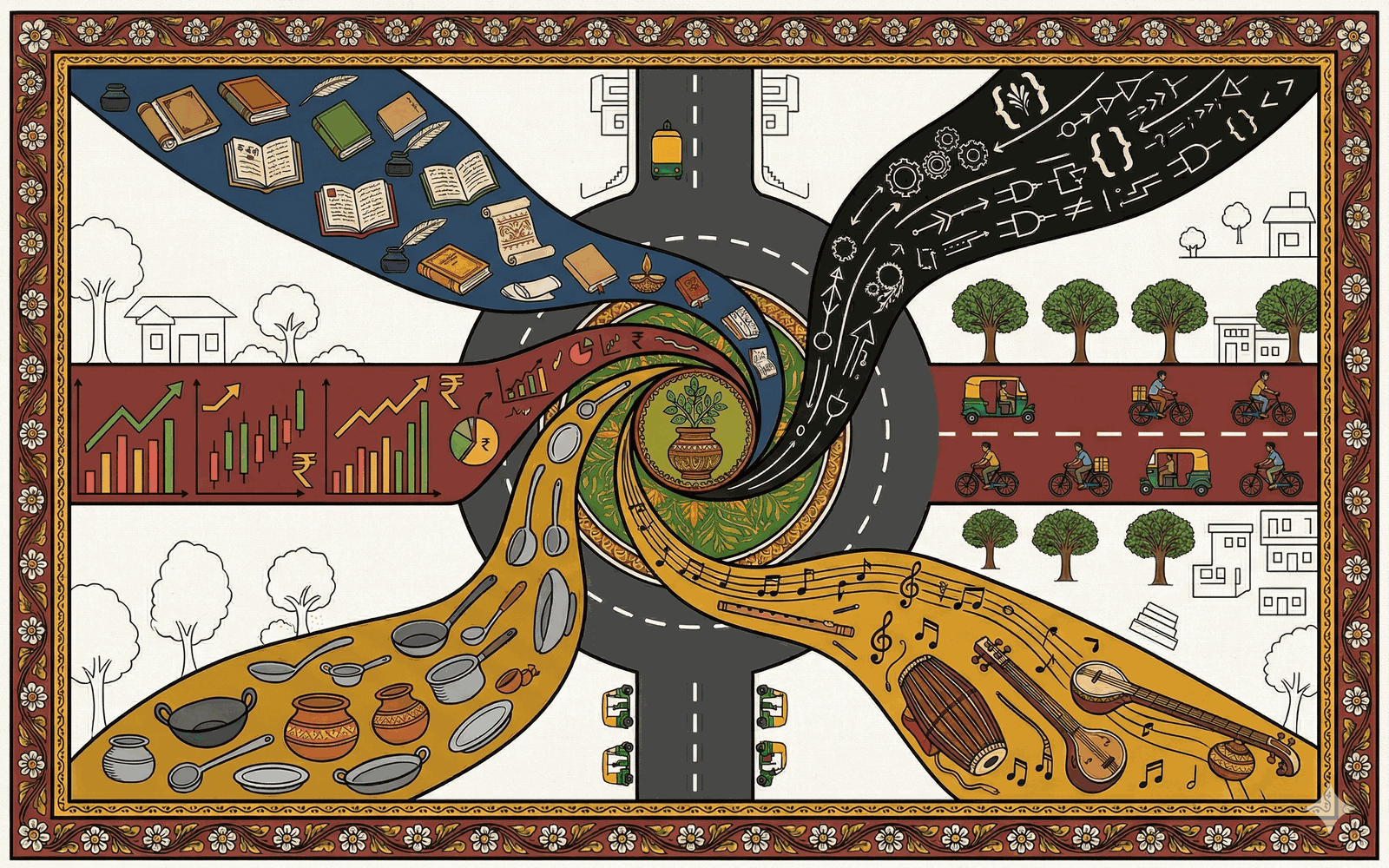
What’s a generalist? Someone who has a range of skills they are proficient in, not just one.
What’s a skill? An activity learnt to do well.
So a generalist is someone who has learnt many activities they can do fairly well. Does that mean a kid learning in school is a generalist? They learn all sorts of subjects from science to social studies, from sports to event management. I guess they are on the path of becoming a generalist.
But something happens when they are in college. They specialise in one subject for which they are paid money. Well at least in the traditional career path this is the way. So what happens to their other skills?
They get rusty. Eventually with time the mind forgets about them. A child who grew up learning a wide variety of skills or activities has to dump it all in favour of one. One which allows them to earn money and be a productive part of society.
So much learning, discarded. Does that mean other subjects were not a productive part? Were they useless? One could argue that other activities built the child for the latter specialisation. One could say that other subjects would help in other aspects of life.
But here is the reality check. Most who specialise never really think about or do stuff they learnt as a child. Maybe it’s lack of time, lack of interest, or just forgotten about. Over a lifetime it really becomes useless because of how little it’s used.
The only argument that survives is that it helped the child build a base. But how many software engineers think about history? Or the constitution? Psychology? Economics? Being good at a sport they played earlier? I would argue it’s a very low number. The learning happened in the past. There is no more thinking from that view.
And what fills that void? Some people I know and talk to — it’s quite apparent, the lack of knowledge in fields unrelated to their jobs. The knowledge which stays is from modern media like Instagram or YouTube, which is not really knowledge. It’s entertainment, half a story, and sometimes dangerously half-knowledge. I am pretty sure a majority of the world’s population prefers this apparent shortcut to knowledge.
But being a generalist is not just about what you can do. It’s also about how you think. The skills may rust, but the way you look at the world — that can stay sharp. Or it can narrow down to a single point of view without you even noticing.
Let’s focus on that — the thinking part. Everyday we are bombarded with news. There might be one which we take more interest in and thus the mind is tasked to think about it.
Maybe it’s about war or local politics. Now when you think about it, you think from the worldview that you have. Being a software engineer I compare many things to CS concepts like encapsulation, extensibility, classes, functions and so on. With my limited knowledge of local politics I form my views about an event.
But the event was presented in a way which most benefits the one who posted it. To boost their attention grab, to let people click on their links so they earn money, to retain engagement for future profits. The real event has little to do with their framing of it.
Yet our unconscious mind will look at the event from the lens the poster created. To be more attention-grabbing and achieve longer retention, a hook will be used — negative words or outlook, power words, saving the real detail till the last so you scroll all the way down.
We don’t stand a chance against this machinery. So the ideas or opinions that you and I form are on the basis of our existing worldview and how the poster has posted it. If I have to say, this is quite a specialised view of watching an event.
To be a generalist here is hard work, by my definition. You will have to find the news from some trustable source. You have to find out the history which led to whatever event is happening. Then you will have to look at all parties involved along with their incentives. So a local political event for a generalist is not just a snapshot.
It’s all the provenance of events as well as the subtle knowledge and connections that form around it.
Now I can hear your resistance. “Do I have to do all this every time I just read one damn local political event?”
Well not quite. Once you understand one event in depth — the knowledge you gained by looking through different lenses, being a generalist — you form a deeper and denser worldview. Similar events, you can form connections much faster. You don’t have to read the same history twice.
So being a generalist is hard work or play depending on the experiencer. It involves curiosity and the drive to look at one thing not just from one framework but many.
But looking outward is only half of it. It involves being aware of the unconscious decisions that you take. They will always be taken, but being aware of them gives you a chance to make them better. Why am I reading about this event? Have I read something similar before? Is it negative or positive? Is it subtly praising someone?
Unconsciously we answer a lot of these questions. Many times we fall to our lizard brain response. Being a generalist, you fall to it a lot less. The generality suffers the moment you stop looking.
The kid in school had it right. They just didn’t know it yet.
I notice things about how we think. And I write about it. Subscribe to not miss the next one.
Comments
built using sutrena